
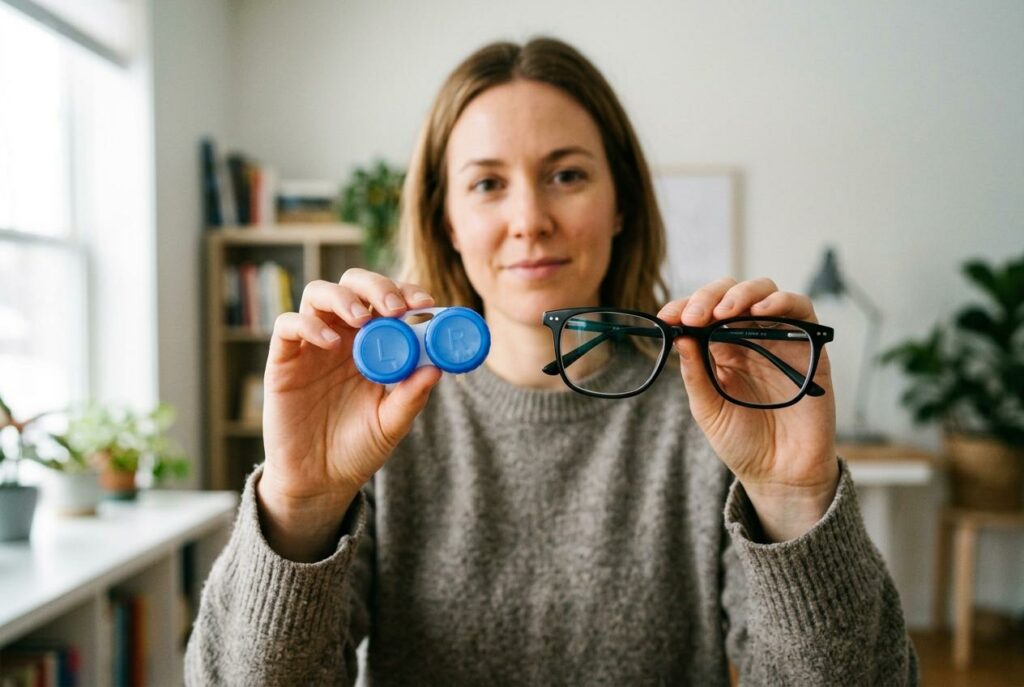
You’ve probably wondered if you can use your glasses prescription to order contact lenses online. It might seem logical that you could—after all, don’t they both correct your vision?
However, ordering contacts isn’t as simple as copying your prescription for glasses. Contact lens and glasses prescriptions are not the same, even though they both correct vision problems. You’ll need a different prescription for each kind of corrective device.
At Urban Optique & Eyecare, our team is here to help patients understand these important distinctions. If you’re interested in trying contacts, the first step is a contact lens fitting.
Key Differences Between Contact & Glasses Prescriptions
The space between your glasses and eyes is known as the vertex distance. This gap affects how strong your prescription needs to be. Your glasses sit about 12 millimeters away from your eyes, while your contact lenses rest directly on your eye, and your prescription needs to account for this fact.
Think of it like adjusting a flashlight beam. When you hold the flashlight close to a wall, you get a small, focused circle of light. Move it farther away, and the circle becomes larger but dimmer.
The stronger your vision correction, the bigger the difference between the two kinds of prescription.
How Your Eye Doctor Calculates Your Prescription
Eye doctors use mathematical formulas to convert between glasses and contact prescriptions. However, these calculations are just the starting point. Trial fittings of your new lenses help confirm that these calculations actually give you clear and comfortable vision.
What Information Each Prescription Contains
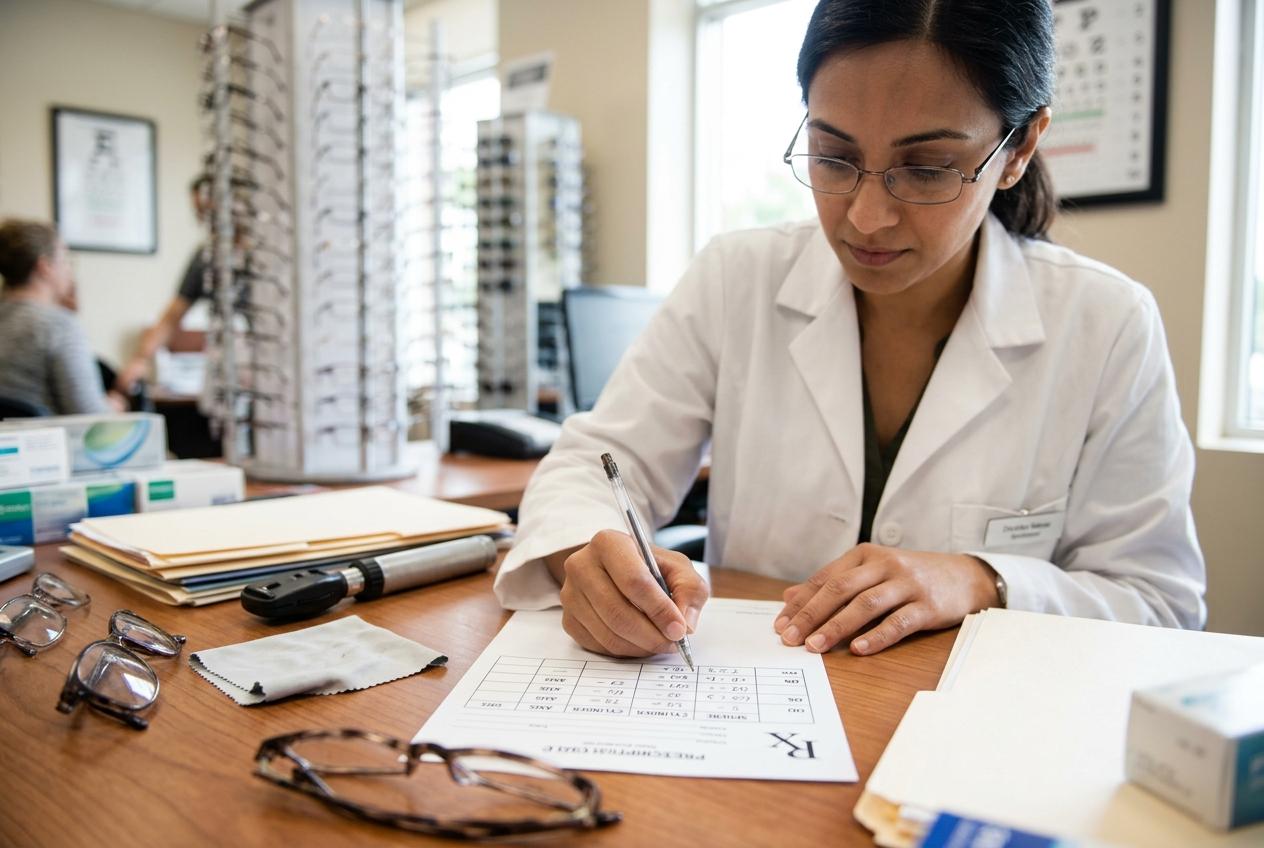
Your glasses prescription includes sphere (overall power), cylinder (astigmatism correction), and axis (astigmatism orientation) values. Contact prescriptions add base curve and diameter measurements that glasses don’t need.
Prescription expiration dates also differ. Glasses and contact lens prescriptions at Urban Optique & Eyecare are valid for one year.
How to Read Your Contact Lens Prescription
The power/sphere value of your prescription corrects your nearsightedness or farsightedness, similarly to glasses. BC stands for base curve and is a measurement of the curvature of your eye. DIA stands for DIA means diameter and describes how wide the lens should be.
You might also see brand names or material types included in your prescription. These are also important, as they affect how the lens fits and feels on your eye.
How to Get Properly Fitted for Contact Lenses
A contact lens fitting involves more than just converting your glasses prescription. Your eye doctor will measure the shape and curve of your eyes, check your eye health, and evaluate your tear film before recommending a pair of lenses.
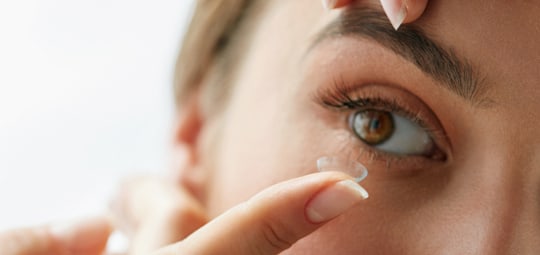
Before your prescription is finalized, your eye doctor will give you a pair of trial lenses to test. If you haven’t worn contact lenses before, or if you simply need a refresher, they’ll also teach you lens insertion and removal techniques.
Why You Need a Contact Lens Prescription
Federal law requires that you have a valid contact lens prescription if you want to buy contact lenses. This rule is designed to protect your eyesight. Improperly fitted contacts can lead to corneal scratches, infections, or other complications that may affect your long-term vision health.
Special Considerations for Your Eye Health
Dry eyes may limit which contact materials work comfortably for you. Some lens types retain moisture better than others. Seasonal allergies can also influence material selection, since certain contacts attract fewer allergens.
Your daily activities help determine the right lens type. If you work long hours at a computer, daily disposable lenses might work better than extended-wear options.
Keep Your Vision Convenient & Comfortable
Ready to explore contact lenses? Our team at Urban Optique & Eyecare can help you determine if contacts are right for you. Schedule your contact lens fitting today to discover the freedom that properly fitted lenses can provide.